370 Results for : debug
-

Shell Programming in Unix, Linux and OS X (eBook, ePUB)
Shell Programming in Unix, Linux and OS X is a thoroughly updated revision of Kochan and Wood's classic Unix Shell Programming tutorial. Following the methodology of the original text, the book focuses on the POSIX standard shell, and teaches you how to develop programs in this useful programming environment, taking full advantage of the underlying power of Unix and Unix-like operating systems. After a quick review of Unix utilities, the book's authors take you step-by-step through the process of building shell scripts, debugging them, and understanding how they work within the shell's environment. All major features of the shell are covered, and the large number of practical examples make it easy for you to build shell scripts for your particular applications. The book also describes the major features of the Korn and Bash shells. Learn how to... Take advantage of the many utilities provided in the Unix system Write powerful shell scripts Use the shell's built-in decision-making and looping constructs Use the shell's powerful quoting mechanisms Make the most of the shell's built-in history and command editing capabilities Use regular expressions with Unix commands Take advantage of the special features of the Korn and Bash shells Identify the major differences between versions of the shell language Customize the way your Unix system responds to you Set up your shell environment Make use of functions Debug scripts Contents at a Glance 1 A Quick Review of the Basics 2 What Is the Shell? 3 Tools of the Trade 4 And Away We Go 5 Can I Quote You on That? 6 Passing Arguments 7 Decisions, Decisions 8 'Round and 'Round She Goes 9 Reading and Printing Data 10 Your Environment 11 More on Parameters 12 Loose Ends 13 Rolo Revisited 14 Interactive and Nonstandard Shell Features A Shell Summary B For More Information- Shop: buecher
- Price: 17.95 EUR excl. shipping
-

Visual Studio Code Distilled
Use Visual Studio Code to write and debug code quickly and efficiently on any platform, for any device, using any programming language, and on the operating system of your choice.Visual Studio Code is an open source and cross-platform development tool that focuses on code editing across a variety of development scenarios, including web, mobile, and cloud development. This second edition of Visual Studio Code Distilled has been updated and expanded with two new chapters on writing apps with Python and building apps for the cloud and deployment to Azure.The book teaches you how to be immediately productive with Visual Studio Code, from the basics to some of the more complex topics. You will learn how to work on individual code files, complete projects, and come away with an understanding of advanced code-editing features that will help you focus on productivity, and source code collaboration with Git.What You Will LearnGet started with practical guidance on Visual Studio Code, including expansive guidance on writing apps with C# and PythonComprehend Visual Studio Code in a way that is not just theory or a list of features, but an approach driven by developer tasks and needsUnderstand integrated support for team collaboration with Git for executing and debugging code, and the many ways you can extend and customize Visual Studio CodeDebug code on multiple platforms through real-world guidance, such as working under corporate networksExpand your coding intelligence from web to mobile to the cloudAcquire valuable tips, tricks, and suggestions from hard-earned, real-world experience to be more productiveWho This Book Is ForAll developers (including JavaScript, Java, NodeJS), not just those with a Microsoft background, who will benefit from learning and using VS code as a cross-platform and cross-language tool- Shop: buecher
- Price: 35.99 EUR excl. shipping
-

STM32F302CBT6 - ARM®Cortex®-M4 Mikrocontroller, 32-bit, 2V, 128 KB, LQFP-48
Die STM32F302xB/STM32F302xC-Familie basiert auf dem leistungsstarken 32-Bit-RISC-Kern Arm® Cortex®-M4 mit FPU mit einer Frequenz von bis zu 72 MHz , einer Speicherschutzeinheit (MPU) + Trace-Makrozelle (ETM). Die Familie umfasst Hochgeschwindigkeits-Embedded-Speicher (bis zu 256 KByte Flash-Speicher, bis zu 40 KByte SRAM) und eine umfangreiche Palette von erweiterten I/Os und Peripheriegeräten, die an zwei APB-Busse angeschlossen sind.Bis zu 2 schnelle 12-Bit-ADCs (5 Msps), 4 Komparatoren, 2 Operationsverstärker, bis zu einem DAC-Kanal, eine Low-Power-RTC, bis zu 5 universell einsetzbare 16-Bit-Timer, einen universellen 32-Bit-Timer und einen Timer für die Motorsteuerung. Bis zu 2 I2Cs, bis zu 3 SPIs (2 SPIs sind mit gemultiplexten Vollduplex-I2Ss), 3 USARTs, bis zu 2 UARTs, CAN und USB. Um die Genauigkeit der Audioklasse zu erreichen, können die I2S-Peripheriegeräte über eine externe PLL getaktet werden.Die Familie STM32F302xB/STM32F302xC arbeitet im Temperaturbereich von -40 bis +85 °C bei einer Spannungsversorgung mit 2,0 bis 3,6 V. Umfangreiche Satz von Energiesparmodi ermöglicht die Entwicklung von Low-Power-Anwendungen. Der Satz der enthaltenen Peripheriegeräte ändert sich mit dem gewählten Gerät.Features• Core: Arm® Cortex®-M4 32-bit CPU with FPU (72 MHz max), single-cycle multiplication and HW division, DSP instruction and MPU (memory protection unit)• Operating conditions:– VDD, VDDA voltage range: 2.0 V to 3.6 V• Memories– 128 to 256 Kbytes of Flash memory– Up to 40 Kbytes of SRAM, with HW parity check implemented on the first 16 Kbytes.• CRC calculation unit• Reset and supply management– Power-on/power-down reset (POR/PDR)– Programmable voltage detector (PVD)– Low-power modes: Sleep, Stop and Standby– VBAT supply for RTC and backup registers• Clock management– 4 to 32 MHz crystal oscillator– 32 kHz oscillator for RTC with calibration– Internal 8 MHz RC with x 16 PLL option– Internal 40 kHz oscillator• Up to 87 fast I/Os– All mappable on external interrupt vectors– Several 5 V-tolerant• Interconnect matrix• 12-channel DMA controller• Two ADCs 0.20 ìS (up to 17 channels) with selectable resolution of 12/10/8/6 bits, 0 to 3.6 V conversion range, single ended/differential input, separate analog supply from 2 to 3.6 V• One 12-bit DAC channel with analog supply from 2.4 to 3.6 V• Four fast rail-to-rail analog comparators with analog supply from 2 to 3.6 V• Two operational amplifiers that can be used in PGA mode, all terminals accessible with analog supply from 2.4 to 3.6 V• Up to 24 capacitive sensing channels supporting touchkey, linear and rotary touch sensors• Up to 11 timers– One 32-bit timer and two 16-bit timers with up to 4 IC/OC/PWM or pulse counter and quadrature (incremental) encoder input– One 16-bit 6-channel advanced-control timer, with up to 6 PWM channels, deadtime generation and emergency stop– One 16-bit timer with 2 IC/OCs, 1 OCN/PWM, deadtime generation and emergency stop– Two 16-bit timers with IC/OC/OCN/PWM, deadtime generation and emergency stop– Two watchdog timers (independent, window)– SysTick timer: 24-bit downcounter– One 16-bit basic timer to drive the DAC• Calendar RTC with Alarm, periodic wakeup from Stop/Standby• Communication interfaces– CAN interface (2.0B Active)– Two I2C Fast mode plus (1 Mbit/s) with 20 mA current sink, SMBus/PMBus, wakeup from STOP– Up to five USART/UARTs (ISO 7816 interface, LIN, IrDA, modem control)– Up to three SPIs, two with multiplexed half/full duplex I2S interface, 4 to 16 programmable bit frames– USB 2.0 full speed interface– Infrared transmitter• Serial wire debug, Cortex®-M4 with FPU ETM, JTAG• 96-bit unique ID- Shop: reichelt elektronik
- Price: 6.19 EUR excl. shipping
-

Raspberry Pi Pico Essentials
The Raspberry Pi Pico is a high-performance microcontroller module designed especially for physical computing. Microcontrollers differ from single-board computers, like the Raspberry Pi 4, in not having an operating system. The Raspberry Pi Pico can be programmed to run a single task very efficiently within real-time control and monitoring applications requiring speed. The 'Pico' as we call it, is based on the fast, efficient, and low-cost dual-core ARM Cortex-M0+ RP2040 microcontroller chip running at up to 133 MHz and sporting 264 KB of SRAM, and 2 MB of Flash memory. Besides its large memory, the Pico has even more attractive features including a vast number of GPIO pins, and popular interface modules like ADC, SPI, I²C, UART, and PWM. To cap it all, the chip offers fast and accurate timing modules, a hardware debug interface, and an internal temperature sensor.The Raspberry Pi Pico is easily programmed using popular high-level languages such as MicroPython and or C/C++. This book is an introduction to using the Raspberry Pi Pico microcontroller in conjunction with the MicroPython programming language. The Thonny development environment (IDE) is used in all the projects described. There are over 50 working and tested projects in the book, covering the following topics:Installing the MicroPython on Raspberry Pi Pico using a Raspberry Pi or a PCTimer interrupts and external interruptsAnalogue-to-digital converter (ADC) projectsUsing the internal temperature sensor and external temperature sensor chipsDatalogging projectsPWM, UART, I²C, and SPI projectsUsing Wi-Fi and apps to communicate with smartphonesUsing Bluetooth and apps to communicate with smartphonesDigital-to-analogue converter (DAC) projectsAll projects given in the book have been fully tested and are working. Only basic programming and electronics experience is required to follow the projects. Brief descriptions, block diagrams, detailed circuit diagrams, and full MicroPython program listings are given for all projects described. Readers can find the program listings on the Elektor web page created to support the book.- Shop: buecher
- Price: 23.99 EUR excl. shipping
-

Nucleo Boards Programming with the STM32CubeIDE
STM32 Nucleo family of processors are manufactured by STMicroelectronics. These are low-cost ARM microcontroller development boards. This book is about developing projects using the popular STM32CubeIDE software with the Nucleo-L476RG development board. In the early Chapters of the book the architecture of the Nucleo family is briefly described.The book covers many projects using most features of the Nucleo-L476RG development board where the full software listings for the STM32CubeIDE are given for each project together with extensive descriptions. The projects range from simple flashing LEDs to more complex projects using modules, devices, and libraries such as GPIO, ADC, DAC, I²C, SPI, LCD, DMA, analogue inputs, power management, X-CUBE-MEMS1 library, DEBUGGING, and others. In addition, several projects are given using the popular Nucleo Expansion Boards. These Expansion Boards plug on top of the Nucleo development boards and provide sensors, relays, accelerometers, gyroscopes, Wi-Fi, and many others. Using an expansion board together with the X-CUBE-MEMS1 library simplifies the task of project development considerably.All the projects in the book have been tested and are working. The following sub-headings are given for each project: Project Title, Description, Aim, Block Diagram, Circuit Diagram, and Program Listing for the STM32CubeIDE.In this book you will learn about STM32 microcontroller architecture;the Nucleo-L476RG development board in projects using the STM32CubeIDE integrated software development tool;external and internal interrupts and DMA;DEBUG, a program developed using the STM32CubeIDE;the MCU in Sleep, Stop, and in Standby modes;Nucleo Expansion Boards with the Nucleo development boards.What you need a PC with Internet connection and a USB port;STM32CubeIDE software (available at STMicroelectronics website free of charge)the project source files, available from the book's webpage hosted by Elektor;Nucleo-L476RG development board;simple electronic devices such as LEDs, temperature sensor, I²C and SPI chips, and a few more;Nucleo Expansion Boards (optional).- Shop: buecher
- Price: 31.99 EUR excl. shipping
-
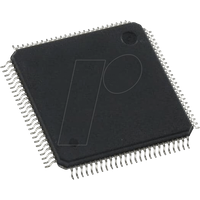
STM32G474VET6 - ARM®Cortex®-M4F Mikrocontroller, 32-bit, 2-3,6V, 512KB, LQFP-100
BeschreibungDie STM32G474xx basieren auf dem leistungsstarken Arm® Cortex®-M4 32-Bit-RISC-Kern. Der Cortex-M4-Kern verfügt über eine Single-Precision-FPU, die die Single-Precision-Datenverarbeitungsanweisungen des Arms und alle Datentypen unterstützt. Implementiert ist ein vollständiger Satz von DSP Anweisungen und eine MPU.Integrierte Hochgeschwindigkeitsspeicher (512 KByte Flash und 128 KByte SRAM), FSMC, Quad SPI Flash Speicherschnittstelle + Peripheriegeräten, die an 2 APB-Busse, 2 AHB-Busse und 1x 32-Bit-Multi-AHB-Busmatrix angeschlossen sind.Integrierte Schutzmechanismen für eingebettete Flash-Speicher + SRAM.Die Vorrichtungen beinhalten Peripheriegeräte, die eine mathematische/arithmetische Funktionsbeschleunigung ermöglichen. - 5x 12-Bit-ADCs- 7x Komparatoren- 6x Operationsverstärker- 7x DAC-Kanäle- 1x Spannungsreferenzpuffer- 1x RTC- 2x 32-Bit-Timer- 3x 16-Bit-PWM-Timer- 7x uni 16-Bit-Timer- 1x 16-Bit LP-Timer- 4x I2Cs- 4x SPIs multiplexed mit zwei halbduplexen I2Ss- 3 USARTs, 2x UART + 1x Low-Power-UART.- 3x FDCAN- 1x SAI- USB-Gerät- UCPDEinige unabhängige Stromversorgungen werden unterstützt, darunter ein analoger unabhängiger Versorgungseingang für ADC, DAC, OPAMPs und Komparatoren. Ein VBAT-Eingang ermöglicht die Sicherung der RTC und Register.Features• Core: Arm® 32-bit Cortex®-M4 CPU with FPU, Adaptive real-time accelerator (ART Accelerator) allowing 0-wait-state execution from Flash memory, frequency up to 170 MHz with 213 DMIPS, MPU, DSP instructions• Operating conditions:– VDD, VDDA voltage range: 1.71 V to 3.6 V• Mathematical hardware accelerators– CORDIC for trigonometric functions acceleration– FMAC: Filter mathematical accelerator• Memories– 512 Kbytes of Flash memory with ECC support, two banks read-while-write, proprietary code readout protection (PCROP), securable memory area, 1 Kbyte OTP– 96 Kbytes of SRAM, with hardware parity check implemented on the first 32 Kbytes– Routine booster: 32 Kbytes of SRAM on instruction and data bus, with hardware parity check (CCM SRAM)– External memory interface for static memories FSMC supporting SRAM, PSRAM, NOR and NAND memories– Quad-SPI memory interface• Reset and supply management– Power-on/power-down reset (POR/PDR/BOR)– Programmable voltage detector (PVD)– Low-power modes: sleep, stop, standby and shutdown– VBAT supply for RTC and backup registers• Clock management– 4 to 48 MHz crystal oscillator– 32 kHz oscillator with calibration– Internal 16 MHz RC with PLL option (± 1%)– Internal 32 kHz RC oscillator (± 5%)• Up to 107 fast I/Os– All mappable on external interrupt vectors– Several I/Os with 5 V tolerant capability• Interconnect matrix• 16-channel DMA controller• 25 x 12-bit ADCs 0.25 ìs, up to 42 channels. Resolution up to 16-bit with hardware oversampling, 0 to 3.6 V conversion range• 7 x 12-bit DAC channels– 3 x buffered external channels 1 MSPS– 4 x unbuffered internal channels 15 MSPS• 7 x ultra-fast rail-to-rail analog comparators• 6 x operational amplifiers that can be used in PGA mode, all terminals accessible• Internal voltage reference buffer (VREFBUF) supporting three output voltages (2.048 V, 2.5 V, 2.95 V)• 17 timers:– HRTIM (Hi-Resolution and complex waveform builder): 6 x16-bit counters, 184 ps resolution, 12 PWM– 2 x 32-bit timer and 2 x 16-bit timers with up to four IC/OC/PWM or pulse counter and quadrature (incremental) encoder input– 3 x 16-bit 8-channel advanced motor control timers, with up to 8 x PWM channels, dead time generation and emergency stop– 1 x 16-bit timer with 2 x IC/OCs, one OCN/PWM, dead time generation and emergency stop– 2 x 16-bit timers with IC/OC/OCN/PWM, dead time generation and emergency stop– 2 x watchdog timers (independent, window)– 1 x SysTick timer: 24-bit downcounter– 2 x 16-bit basic timers– 1 x low-power timer• Calendar RTC with alarm, periodic wakeup from stop/standby• Communication interfaces– 3 x FDCAN controller supporting flexible data rate– 4 x I2C Fast mode plus (1 Mbit/s) with 20 mA current sink, SMBus/PMBus, wakeup from stop– 5 x USART/UARTs (ISO 7816 interface, LIN, IrDA, modem control)– 1 x LPUART– 4 x SPIs, 4 to 16 programmable bit frames, 2 x with multiplexed half duplex I2S interface– 1 x SAI (serial audio interface)– USB 2.0 full-speed interface with LPM and BCD support– IRTIM (infrared interface)– USB Type-C™ /USB power delivery controller (UCPD)• True random number generator (RNG)• CRC calculation unit, 96-bit unique ID• Development support: serial wire debug (SWD), JTAG, Embedded trace macrocell™- Shop: reichelt elektronik
- Price: 11.15 EUR excl. shipping
-

Cisco Firepower Threat Defense (FTD) (eBook, PDF)
The authoritative visual guide to Cisco Firepower Threat Defense (FTD) This is the definitive guide to best practices and advanced troubleshooting techniques for the Cisco flagship Firepower Threat Defense (FTD) system running on Cisco ASA platforms, Cisco Firepower security appliances, Firepower eXtensible Operating System (FXOS), and VMware virtual appliances. Senior Cisco engineer Nazmul Rajib draws on unsurpassed experience supporting and training Cisco Firepower engineers worldwide, and presenting detailed knowledge of Cisco Firepower deployment, tuning, and troubleshooting. Writing for cybersecurity consultants, service providers, channel partners, and enterprise or government security professionals, he shows how to deploy the Cisco Firepower next-generation security technologies to protect your network from potential cyber threats, and how to use Firepower's robust command-line tools to investigate a wide variety of technical issues. Each consistently organized chapter contains definitions of keywords, operational flowcharts, architectural diagrams, best practices, configuration steps (with detailed screenshots), verification tools, troubleshooting techniques, and FAQs drawn directly from issues raised by Cisco customers at the Global Technical Assistance Center (TAC). Covering key Firepower materials on the CCNA Security, CCNP Security, and CCIE Security exams, this guide also includes end-of-chapter quizzes to help candidates prepare. · Understand the operational architecture of the Cisco Firepower NGFW, NGIPS, and AMP technologies · Deploy FTD on ASA platform and Firepower appliance running FXOS · Configure and troubleshoot Firepower Management Center (FMC) · Plan and deploy FMC and FTD on VMware virtual appliance · Design and implement the Firepower management network on FMC and FTD · Understand and apply Firepower licenses, and register FTD with FMC · Deploy FTD in Routed, Transparent, Inline, Inline Tap, and Passive Modes · Manage traffic flow with detect-only, block, trust, and bypass operations · Implement rate limiting and analyze quality of service (QoS) · Blacklist suspicious IP addresses via Security Intelligence · Block DNS queries to the malicious domains · Filter URLs based on category, risk, and reputation · Discover a network and implement application visibility and control (AVC) · Control file transfers and block malicious files using advanced malware protection (AMP) · Halt cyber attacks using Snort-based intrusion rule · Masquerade an internal host's original IP address using Network Address Translation (NAT) · Capture traffic and obtain troubleshooting files for advanced analysis · Use command-line tools to identify status, trace packet flows, analyze logs, and debug messages- Shop: buecher
- Price: 35.95 EUR excl. shipping
-

Learn More Python 3 the Hard Way (eBook, PDF)
Transform Your Ideas into High-Quality Python Code! Zed Shaw has perfected the world's best system for becoming a truly effective Python 3.x developer. Follow it and you will succeed-just like the tens of millions of programmers he's already taught. You bring the discipline, commitment, and persistence; the author supplies everything else. In Learn Python 3 the Hard Way, Zed Shaw taught you the basics of Programming with Python 3. Now, in Learn More Python 3 the Hard Way, you'll go far beyond the basics by working through 52 brilliantly crafted projects. Each one helps you build a key practical skill, combining demos to get you started and challenges to deepen your understanding. Zed then teaches you even more in 12 hours of online videos, where he shows you how to break, fix, and debug your code. First, you'll discover how to analyze a concept, idea, or problem to implement in software. Then, step by step, you'll learn to design solutions based on your analyses and implement them as simply and elegantly as possible. Throughout, Shaw stresses process so you can get started and build momentum, creativity to solve new problems, and quality so you'll build code people can rely on. Manage complex projects with a programmer's text editor Leverage the immense power of data structures Apply algorithms to process your data structures Master indispensable text parsing and processing techniques Use SQL to efficiently and logically model stored data Learn powerful command-line tools and skills Combine multiple practices in complete projects It'll be hard at first. But soon, you'll just get it-and that will feel great! This course will reward you for every minute you put into it. Soon, you'll go beyond merely writing code that runs: you'll craft high-quality Python code that solves real problems. You'll be a serious Python programmer. Perfect for Everyone Who's Already Started Working with Python, including Junior Developers and Seasoned Python Programmers Upgrading to Python 3.6+ Register your product at informit.com/register for convenient access to downloads, updates, and/or corrections as they become available.- Shop: buecher
- Price: 21.95 EUR excl. shipping
-

Hands-On RTOS with Microcontrollers
Build a strong foundation in designing and implementing real-time systems with the help of practical examples Key Features Get up and running with the fundamentals of RTOS and apply them on STM32 Enhance your programming skills to design and build real-world embedded systems Get to grips with advanced techniques for implementing embedded systems Book Description A real-time operating system (RTOS) is used to develop systems that respond to events within strict timelines. Real-time embedded systems have applications in various industries, from automotive and aerospace through to laboratory test equipment and consumer electronics. These systems provide consistent and reliable timing and are designed to run without intervention for years. This microcontrollers book starts by introducing you to the concept of RTOS and compares some other alternative methods for achieving real-time performance. Once you've understood the fundamentals, such as tasks, queues, mutexes, and semaphores, you'll learn what to look for when selecting a microcontroller and development environment. By working through examples that use an STM32F7 Nucleo board, the STM32CubeIDE, and SEGGER debug tools, including SEGGER J-Link, Ozone, and SystemView, you'll gain an understanding of preemptive scheduling policies and task communication. The book will then help you develop highly efficient low-level drivers and analyze their real-time performance and CPU utilization. Finally, you'll cover tips for troubleshooting and be able to take your new-found skills to the next level. By the end of this book, you'll have built on your embedded system skills and will be able to create real-time systems using microcontrollers and FreeRTOS. What you will learn Understand when to use an RTOS for a project Explore RTOS concepts such as tasks, mutexes, semaphores, and queues Discover different microcontroller units (MCUs) and choose the best one for your project Evaluate and select the best IDE and middleware stack for your project Use professional-grade tools for analyzing and debugging your application Get FreeRTOS-based applications up and running on an STM32 board Who this book is for This book is for embedded engineers, students, or anyone interested in learning the complete RTOS feature set with embedded devices. A basic understanding of the C programming language and embedded systems or microcontrollers will be helpful.- Shop: buecher
- Price: 52.99 EUR excl. shipping
-

Advances in Electronic Testing
Advances in Electronic Testing: Challenges and Methodologies is a new type of edited volume in the Frontiers in Electronic Testing book series devoted to recent advances in electronic circuits testing. The book is a comprehensive elaboration on important topics which capture major research and development efforts today. The motivation and inspiration behind this book is to deliver a thorough text that focuses on the evolution of test technology, provides insight about the abiding importance of discussed topics, records today s state-of-the-art and industrial practices and trends, reveals the challenges for emerging testing methodologies, and envisages the future of this journey.The book consists of eleven edited chapters written by experts in Defect-Oriented Testing, Nanometer Technologies Failures and Testing, Silicon Debug, Delay Testing, High-Speed Test Interfaces, DFT-Oriented Low-Cost Testers, Embedded Cores and System-on-Chip Testing, Memory Testing, Mixed-Signal Testing, RF Testing and Loaded Board Testing. Contributing authors are affiliated with (in alphabetical order) Agilent, ARM, Balearic Islands Univ., IBM, Inovys, Intel, LogicVision, Magma, Mentor Graphics, New Mexico Univ., Sandia National Labs, Synopsys, Teradyne and Texas Instruments.Advances in Electronic Testing: Challenges and Methodologies is an advanced textbook and reference point for senior undergraduate and graduate students in MSc or PhD tracks, professors and research leaders in the electronic testing domain. It is also for industry design and test engineers and managers seeking a global view and understanding of test technology practices and methodologies and a dense elaboration on test-related issues they face in their development projects."There is a definite need for documenting the advances in testing I find the work of this edited volume by Dimitris Gizopoulos and his team of authors to be significant and timely. [ ]the book provides, besides novel test methodologies, a collective insight into the emerging aspects of testing. This, I think, is beneficial to practicing engineers and researchers both of whom must stay at the forefront of technology. [ ]This latest addition to the Frontiers Series is destined to serve an important role."From the Foreword by Vishwani D. Agrawal, Consulting EditorFrontiers in Electronic Testing Book Series- Shop: buecher
- Price: 47.99 EUR excl. shipping